
Digital transformation is fundamentally changing how organizations manage critical physical assets. Industries such as manufacturing, energy, utilities, transportation, mining, oil gas, and infrastructure are under constant pressure to improve asset reliability, reduce downtime, control maintenance costs, and maximize operational efficiency. Traditional maintenance practices based on reactive or scheduled servicing are no longer sufficient in today's connected industrial landscape. Instead, organizations are investing in intelligent asset management platforms that combine real-time operational visibility with predictive insights to optimize the complete asset lifecycle. As a result, SPARK Matrix™: Enterprise Asset Management Q4, 2025 highlights one of the fastest-evolving enterprise software markets supporting Industry 4.0 initiatives worldwide.
QKS Group's Enterprise Asset Management market research provides a comprehensive assessment of the global Enterprise Asset Management market, examining emerging technology trends, competitive dynamics, evolving customer requirements, and future growth opportunities. Modern enterprise asset management software has evolved far beyond computerized maintenance management systems (CMMS). Today's Enterprise Asset Management (EAM) platforms integrate Artificial Intelligence (AI), Industrial Internet of Things (IIoT), machine learning, cloud computing, digital twins, predictive analytics, and mobile technologies to transform maintenance from a reactive function into a strategic business capability.
For organizations asking what is enterprise asset management, EAM refers to a comprehensive software platform designed to manage physical assets throughout their entire lifecycle—from planning, acquisition, commissioning, maintenance, inspection, and operation to retirement and replacement. Modern EAM platforms help organizations maximize asset availability, reduce operational risks, improve workforce productivity, optimize maintenance planning, and support regulatory compliance while lowering total cost of ownership.
One of the most significant trends reshaping the enterprise asset management market is the integration of Industrial IoT technologies. Connected sensors installed on critical industrial assets continuously capture operational parameters such as vibration, temperature, pressure, energy consumption, and equipment performance. These real-time data streams allow organizations to monitor asset health continuously rather than relying solely on scheduled inspections. Combined with AI-powered predictive analytics, EAM platforms can forecast equipment failures before they occur, enabling predictive maintenance strategies that significantly reduce unplanned downtime and maintenance costs.
Artificial intelligence is becoming a major differentiator within Enterprise Asset Management software. AI-driven analytics automate work order prioritization, optimize maintenance schedules, recommend spare parts inventory levels, and improve workforce allocation. Machine learning algorithms continuously learn from historical maintenance records and operational data, allowing organizations to identify recurring failure patterns and recommend optimal maintenance strategies. As AI capabilities continue to mature, intelligent automation is becoming a core capability across leading EAM platforms.
Digital twin technology is also transforming enterprise asset management. Digital twins create virtual representations of physical assets, enabling organizations to simulate operational scenarios, evaluate maintenance strategies, predict equipment degradation, and optimize asset performance before implementing changes in the physical environment. This capability enhances engineering collaboration while reducing operational risks and improving long-term asset reliability.
Cloud computing continues to accelerate Enterprise Asset Management adoption by providing organizations with scalable deployment models, centralized asset visibility, and easier integration across geographically distributed operations. Cloud-native EAM solutions support mobile workforces, remote maintenance teams, and multi-site asset management while reducing infrastructure complexity and implementation costs. Mobile-enabled maintenance applications further empower field technicians with real-time work orders, inspection checklists, digital documentation, barcode scanning, and offline capabilities that improve service efficiency.
Another defining characteristic of modern EAM platforms is their growing convergence with adjacent enterprise systems. Asset Performance Management (APM) has emerged as a complementary discipline focused on continuous equipment health monitoring, predictive maintenance, and reliability optimization. Leading organizations increasingly combine EAM and APM capabilities into unified asset intelligence platforms where maintenance execution and reliability analytics continuously inform one another. This closed-loop approach enables proactive decision-making while maximizing equipment uptime and extending asset lifespan.
Enterprise Asset Management solutions are also becoming deeply integrated with Manufacturing Execution Systems (MES), Enterprise Resource Planning (ERP), Geographic Information Systems (GIS), Supply Chain Management (SCM), and industrial automation platforms. This integration enables seamless information flow between operations, maintenance, procurement, inventory management, finance, and executive decision-making. Organizations benefit from improved maintenance planning, optimized spare parts inventory, better production scheduling, and enhanced financial visibility across enterprise operations.
Sustainability objectives are further influencing Enterprise Asset Management investments. Organizations increasingly rely on EAM platforms to optimize energy consumption, improve equipment efficiency, extend asset lifecycles, reduce maintenance waste, and support environmental compliance initiatives. Intelligent maintenance strategies help reduce carbon emissions while improving overall operational sustainability and supporting Environmental, Social, and Governance (ESG) objectives.
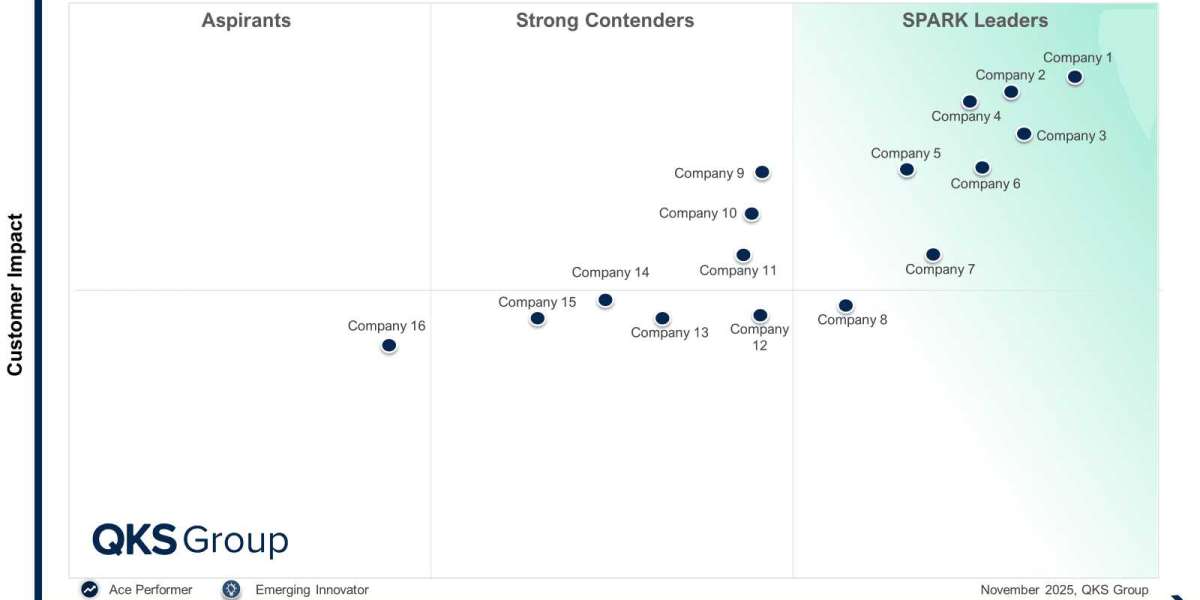
The SPARK Matrix™: Enterprise Asset Management Q4, 2025 evaluates 16 leading vendors based on two primary dimensions: Technology Excellence and Customer Impact. QKS Group's proprietary evaluation framework provides technology buyers with a comprehensive assessment of each vendor's product capabilities, innovation strategy, scalability, customer experience, implementation flexibility, partner ecosystem, and market execution.
The vendors evaluated include Accruent, Aptean, Brightly Software, eMaint, Eptura, Hexagon, Hitachi Energy, IBM, Ideagen Devonway, IFS Ultimo, MaintainX, Pragma, Ramco Systems, SAP, ServiceNow, and UpKeep. Each vendor has been assessed across a broad range of criteria, including asset lifecycle management, work order management, maintenance planning, inventory and procurement management, AI-enabled predictive maintenance, IIoT connectivity, digital twin capabilities, mobile workforce support, cloud deployment, enterprise scalability, interoperability, customer support, and overall value proposition.
As Industry 4.0 initiatives continue expanding across global industries, Enterprise Asset Management software is becoming a foundational component of digital industrial transformation. Organizations are no longer investing in EAM solely to manage maintenance activities—they are adopting intelligent asset management platforms that support operational resilience, business continuity, predictive decision-making, and enterprise-wide optimization. The convergence of AI, IIoT, cloud computing, digital twins, and advanced analytics will continue redefining how organizations manage critical assets over the coming years.
QKS Group's SPARK Matrix™: Enterprise Asset Management Q4, 2025 serves as a strategic decision-making resource for technology buyers evaluating Enterprise Asset Management solutions and for vendors seeking to benchmark their competitive positioning. By delivering comprehensive market intelligence, technology assessments, and vendor comparisons, the research enables organizations to identify the most suitable partners for their digital asset management transformation initiatives while navigating the rapidly evolving Enterprise Asset Management software landscape.